
Get In Touch
- Email contact@anishkaparmar.com
- Address 544-Krupal City Centre, Ashram Road, Ahmedabad (Gujarat) India.
- Follow us

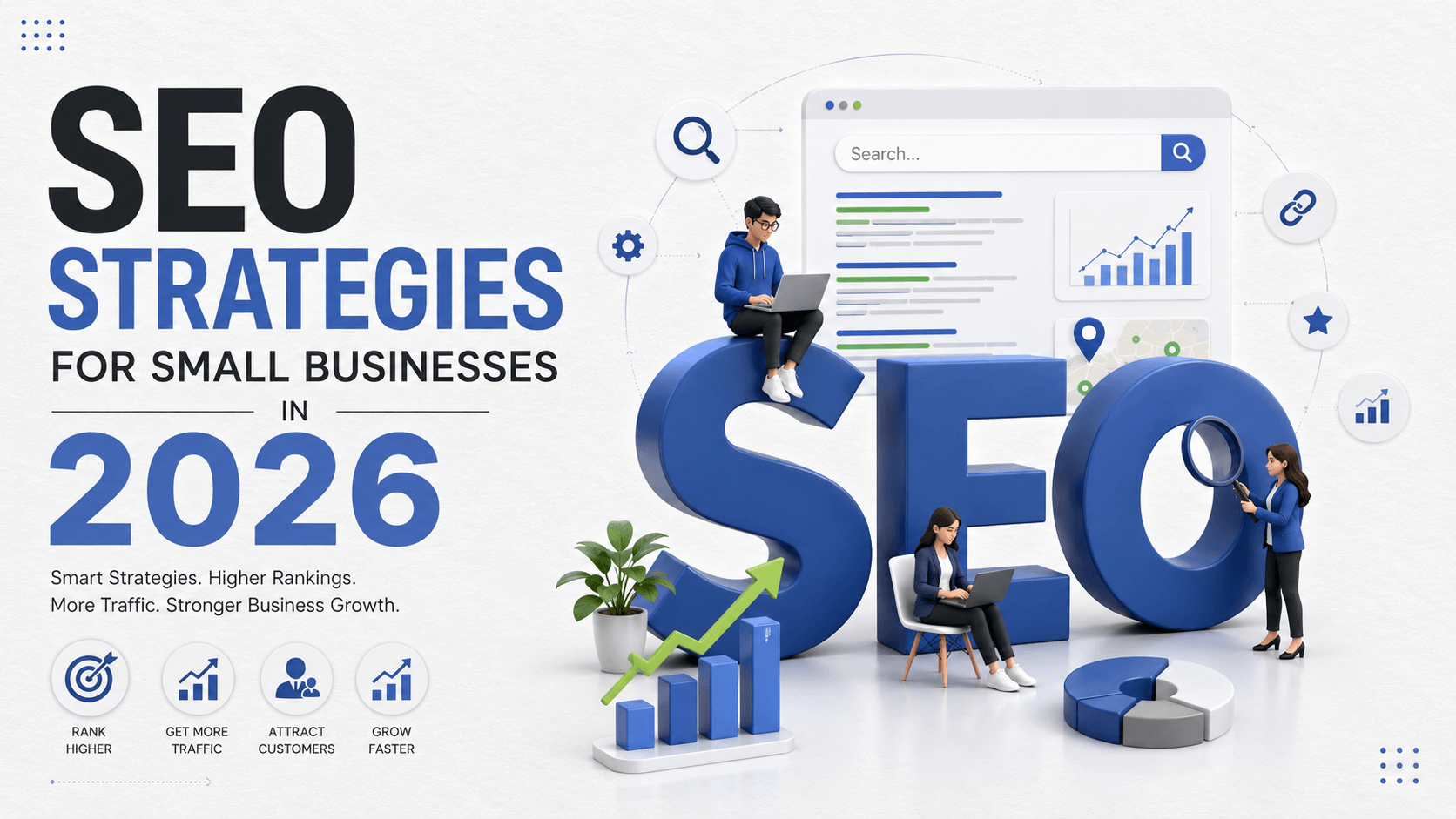
SEO Strategies for Small Businesses in 2026
Discover proven SEO strategies to improve Google visibility, attract local customers, generate organic traffic, and learn SEO Strategies for Small Businesses in 2026 online. For a small business, being visible online can make the difference between being discovered by potential customers and being overlooked by competitors. When someone searches for a product, service, restaurant, professional, or local business on Google, they usually don’t browse through dozens of pages. They tend to focus on the results that appear most relevant and trustworthy.
That’s where Search Engine Optimization (SEO) becomes important. SEO helps search engines understand your website while helping potential customers discover your business when they’re actively searching for what you offer. But SEO in 2026 is no longer simply about adding keywords to a webpage. Modern SEO involves helpful content, search intent, technical performance, local visibility, user experience, structured data, trustworthy information, digital authority, and increasingly, visibility across AI-powered search experiences.
For small businesses, this can actually be an opportunity. You don’t necessarily need the biggest marketing budget to compete. A focused strategy targeting the right audience, locations, services, and search queries can produce meaningful results over time.
In this guide, we’ll explore 10 practical SEO strategies for small businesses in 2026 and explain how you can use them to build sustainable organic visibility and generate more qualified leads.
1. 🎯 Understand Search Intent Before Choosing Keywords
Successful SEO Strategies for Small Businesses in 2026 starts with understanding what people actually want when they search.
A keyword isn’t valuable simply because it receives a large number of searches.
You need to understand whether the person searching is looking for information, comparing options, finding a specific business, or ready to purchase.
For example, someone searching “what is SEO” has informational intent.
Someone searching “SEO agency near me” has much stronger commercial or local intent.
Small businesses should prioritize keywords that are closely connected to their products and services.
Create separate content for informational, commercial, navigational, and transactional searches.
Study the pages already ranking for your target keyword to understand what Google considers useful.
Look at the questions, topics, formats, and information those pages provide.
Then create something genuinely useful rather than simply rewriting competitors.
The goal isn’t to attract any visitor; it’s to attract the right visitor.
2. 🔍 Build a Smart Keyword Strategy
Keyword research remains an important part of SEO, but small businesses should approach it strategically.
Instead of trying to rank immediately for extremely competitive keywords, identify specific terms relevant to your products, services, audience, and location.
Long-tail keywords can be particularly useful because they often reveal a more specific search intent.
For example, “SEO” is extremely broad, while “SEO Strategies for Small Businesses in 2026” communicates a much more specific need.
Create keyword groups around your core services.
Then build dedicated pages and useful articles around those topics.
Avoid placing dozens of unrelated keywords on a single webpage.
Each page should have a clear primary topic and purpose.
Use keywords naturally in titles, headings, body content, URLs, image alt text, and relevant metadata.
Most importantly, write for humans first and search engines second.
3. 📍 Make Local SEO a Priority
For many small businesses, local SEO can be one of the highest-value SEO strategies.
Customers often search for businesses using location-based queries such as “near me,” city names, neighborhoods, or specific service areas.
Make sure your business information is accurate and consistent across important online platforms.
Create and maintain a complete Google Business Profile with your correct business name, category, services, hours, contact information, website, photos, and other relevant details.
Add location-specific information to your website where it genuinely helps customers.
Create dedicated location or service-area pages when they provide unique value.
Encourage genuine customers to leave honest reviews.
Respond professionally to reviews and questions.
Build relationships with relevant local organizations and get SEO strategies for small businesses in 2026.
For a business serving Ahmedabad and Gujarat, for example, locally relevant content can help establish stronger geographic relevance.
Local SEO should ultimately make it easier for nearby customers to discover, evaluate, and contact your business.
4. ✍️ Create Helpful, Original & Experience-Based Content
Content remains one of the most powerful ways for a small business to build organic visibility.
But publishing hundreds of shallow AI-generated articles isn’t a sustainable strategy.
Instead, create content that demonstrates genuine knowledge and provides a useful answer to a specific audience.
Write guides that solve real customer problems.
Answer questions customers repeatedly ask before purchasing.
Share practical examples, comparisons, tutorials, checklists, case studies, and industry insights.
Include your own experience and expertise wherever possible.
Use AI as a productivity assistant when appropriate, but review, edit, fact-check, and improve everything before publishing.
Don’t create articles solely because a keyword tool says the topic has search volume.
Create content because your potential customers actually need it.
Over time, a strong content library can establish your website as a useful resource within your niche.
5. ⚙️ Improve Technical SEO & Website Performance
Great content won’t perform at its full potential if your website has serious technical problems.
Start by making sure search engines can crawl and index your important pages.
Check your XML sitemap, robots.txt configuration, canonical URLs, redirects, broken links, and indexing status.
Your website should work properly on mobile devices because a large portion of web traffic comes from smartphones.
Pay attention to page speed and Core Web Vitals.
Compress unnecessarily large images and use modern formats where appropriate.
Minimize unnecessary scripts and plugins.
Make your navigation logical and easy to understand.
Use HTTPS and keep your website software, themes, and plugins updated.
Technical SEO Strategies for Small Businesses in 2026 isn’t about making your website complicated.
It’s about creating a clean, accessible, fast, secure foundation that works well for both users and search engines.
6. 🧠 Optimize for AI Search & Modern Search Experiences
Search is becoming increasingly conversational and AI-assisted.
People may discover information through traditional search results as well as AI-powered answers and other search experiences.
This makes it even more important to create content that is clear, trustworthy, well-structured, and genuinely useful.
Answer important questions directly.
Use descriptive headings and logical sections.
Support important claims with credible information where appropriate.
Build topical depth instead of publishing disconnected articles.
Clearly demonstrate your expertise and experience.
Keep your business information accurate across your website and important external profiles.
Create content that can be easily understood and summarized without losing important context.
Don’t chase every new AI-search trend with gimmicks.
Focus on the fundamentals: useful information, strong expertise, clear structure, technical quality, and trust.
7. 🔗 Build High-Quality Backlinks & Digital Authority
Backlinks remain an important component of website authority, but quality matters more than simply collecting large numbers of links.
A link from a relevant and trustworthy website can be much more valuable than dozens of unrelated links.
Small businesses can build links by creating genuinely useful resources.
Publish original research, statistics, guides, tools, checklists, or industry resources.
Collaborate with relevant local businesses and organizations.
Get listed in legitimate industry and local directories when appropriate.
Participate in relevant professional communities.
Consider digital PR when your business has something genuinely newsworthy.
Avoid buying large quantities of low-quality backlinks or participating in manipulative link schemes.
A strong backlink profile should develop naturally from the value your business provides.
Think of backlinks as recommendations from other websites, not simply an SEO number.
8. 📱 Optimize Your Website for Mobile & User Experience
A website can rank well but still fail to generate customers if visitors struggle to use it.
Your website should provide a smooth experience across smartphones, tablets, and desktops.
Use readable typography and sufficient spacing.
Make buttons and navigation elements easy to interact with on mobile screens.
Ensure important information isn’t buried under unnecessary animations or pop-ups.
Make contact forms simple.
Display important business information clearly.
Use compelling but honest calls to action.
Test your website on different devices and browsers by knowing SEO strategies for small businesses in 2026.
Pay attention to how quickly users can find the information they’re looking for.
SEO and conversion optimization should work together.
Getting someone to your website is only half the job; you also need to give them a reason and an easy way to take the next step.
9. ⭐ Use Reviews, Trust Signals & Business Information
Trust can strongly influence whether a visitor chooses your business.
Make important information about your company easy to verify.
Clearly communicate who you are, what you offer, where you operate, and how customers can contact you.
Display genuine customer reviews where appropriate.
Add relevant testimonials and case studies.
Show examples of your work when possible.
Create an informative About page that demonstrates your expertise.
Keep contact information consistent.
Use appropriate structured data to help search engines understand relevant information about your business.
Don’t create fake reviews or misleading claims.
Authenticity matters.
A visitor should be able to quickly answer:
“Is this business legitimate, relevant to my needs, and trustworthy?”
Your website should make that answer easy.
10. 📊 Measure SEO Results & Continuously Improve
SEO isn’t a one-time task.
Search trends change, competitors improve, websites evolve, and customer behavior shifts.
That’s why you need to measure your performance regularly.
Monitor organic traffic and search queries.
Track which pages are generating impressions and clicks.
Identify pages that receive impressions but relatively few clicks.
Look for keywords where you’re ranking close to page one.
Monitor conversions such as contact-form submissions, calls, enquiries, purchases, or bookings.
Use analytics and search performance tools to understand what visitors do after arriving on your website.
Update older content when information becomes outdated.
Improve pages that aren’t meeting user intent.
Test different titles and descriptions where appropriate.
The best SEO Strategies for Small Businesses in 2026 is a continuous cycle:
Research → Create → Optimize → Measure → Improve → Repeat.
🚀 Bonus: 2026 SEO Checklist for Small Businesses
Before publishing or optimizing a page, ask:
✅ Does this page solve a real customer problem?
✅ Is the search intent clear?
✅ Does it have a focused primary topic?
✅ Is the content original and useful?
✅ Is the website mobile-friendly?
✅ Does the page load efficiently?
✅ Are the title and meta description compelling?
✅ Are headings logically structured?
✅ Are internal links relevant?
✅ Are images optimized?
✅ Is the business information accurate?
✅ Are local signals consistent?
✅ Is the content trustworthy and up to date?
✅ Is there a clear conversion opportunity?
If most answers are yes, you’re building a much stronger SEO foundation.
📈 How Long Does SEO Take for a Small Business?
SEO usually isn’t an overnight marketing strategy.
The timeline depends on factors such as competition, website quality, existing authority, content quality, location, industry, and how consistently the strategy is implemented.
Some improvements can appear relatively quickly, while competitive keywords may take considerably longer.
Small businesses should focus on sustainable growth rather than chasing instant rankings.
Instead of asking only:
“How quickly can I rank #1?”
Ask:
“How can I become the most useful and trustworthy result for my target customer?”
That mindset leads to better long-term SEO.
Conclusion: SEO Strategies for Small Businesses in 2026
SEO Strategies for small businesses in 2026 is about much more than keywords and rankings.
For small businesses, successful SEO means creating a strong digital foundation that combines helpful content, local visibility, technical performance, user experience, credibility, relevant links, and continuous optimization.
The good news is that small businesses can compete by being highly relevant to specific audiences and locations.
You don’t need to rank for every keyword.
You need to become visible when the right customer searches for the products or services you provide.
Start with your website foundation, understand your customers’ search behavior, optimize your local presence, publish genuinely helpful content, and measure your results.
SEO is a long-term investment, but when done correctly, it can become one of the most sustainable sources of qualified traffic and business growth.
🚀 Ready to Grow Your Business with SEO?
Your customers are already searching online. The question is:
Can they find your business?
Let’s turn your website into a powerful business-growth tool.
Contact Anishka Parmar today and start building your SEO strategy.