
Get In Touch
- Email contact@anishkaparmar.com
- Address 544-Krupal City Centre, Ashram Road, Ahmedabad (Gujarat) India.
- Follow us

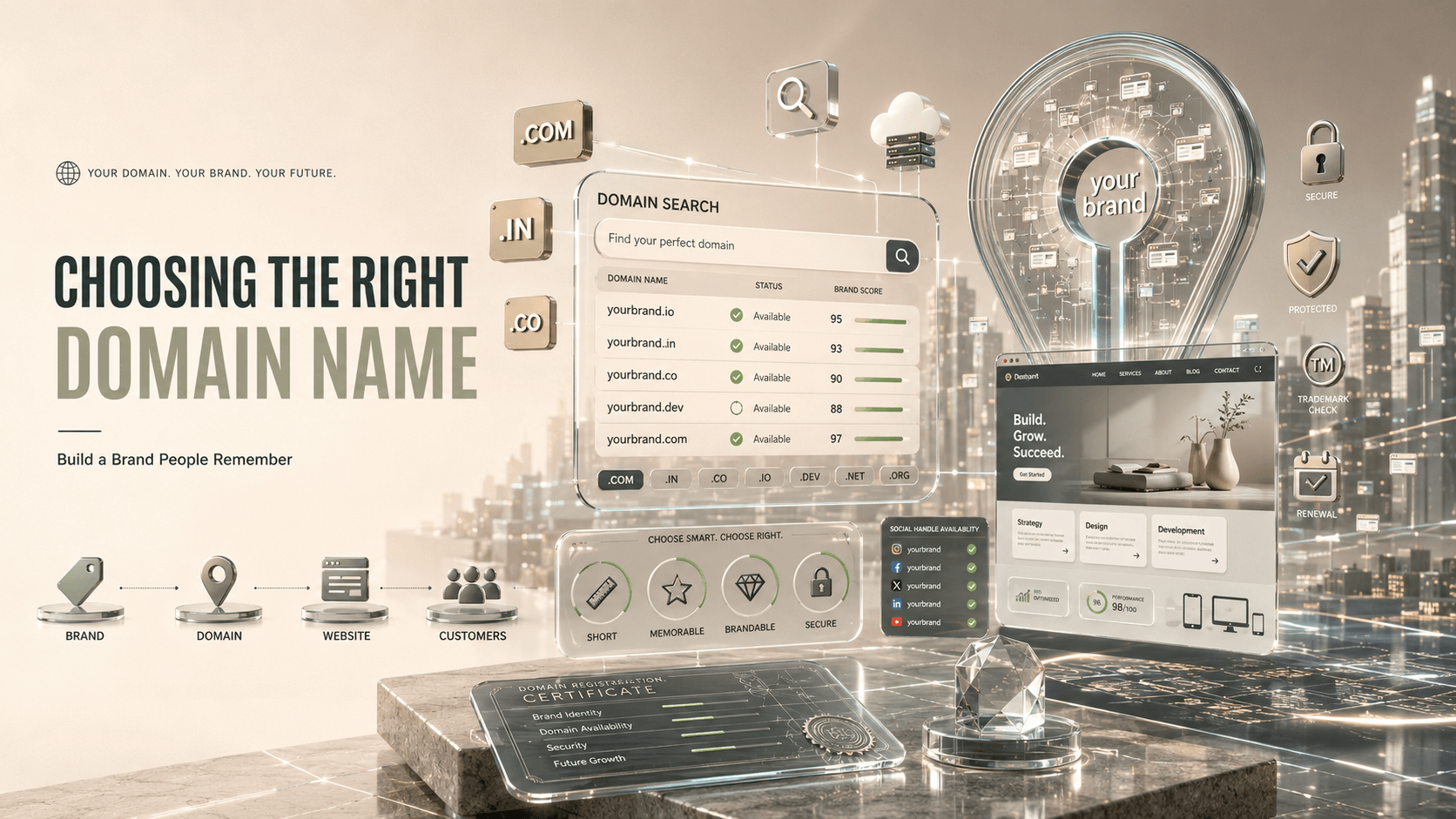
Complete Guide: Choosing the Right Domain Name for Your Brand in 2026
Imagine discovering a business online that looks professional, but its website address is long, complicated, difficult to spell, or filled with unnecessary numbers and hyphens.
Would you remember it?
Probably not.
Your domain name is often one of the first things potential customers encounter when they discover your business online. Complete Guide: Choosing the Right Domain Name for Your Brand in 2026 is important. It can appear on business cards, social media profiles, advertisements, search results, email addresses, packaging, and promotional materials.
That’s why choosing the right domain name should not be treated as a quick technical decision.
A great domain can strengthen your brand identity, make your business easier to remember, improve your credibility, and create a strong foundation for your website and digital marketing strategy.
However, choosing a domain isn’t simply about finding an available .com. You need Complete Guide: Choosing the Right Domain Name for Your Brand in 2026 to think about brandability, simplicity, pronunciation, spelling, domain extensions, trademarks, SEO, social media consistency, security, and future business expansion.
In this complete guide, we’ll explore 10 important factors for choosing the right domain name for your brand in 2026.
1. Choose a Domain Name That Represents Your Brand
Your domain should reflect the identity and personality of your business.
It should ideally be connected to your brand name, product, service, or overall business concept.
A strong domain helps customers immediately understand who you are.
For example, a business selling handmade furniture could choose a brand-focused name rather than a complicated keyword combination.
Avoid selecting a domain simply because it contains a popular keyword.
Your domain should be memorable enough to become a recognizable brand.
Think about how the name will look on your website, business cards, advertisements, and social profiles.
Consider whether the name still makes sense if your business expands into new products or services.
A flexible brand name gives you more room to grow.
Ultimately, your domain should feel like a digital home for your brand, not just an SEO keyword.
2. Keep Your Domain Name Short and Simple
One of the most important domain-name principles is simplicity.
Shorter names are generally easier for people to remember and type.
A complicated domain increases the possibility of spelling mistakes.
Avoid unnecessarily long combinations of words.
For example, a short brandable name is usually easier to communicate than a sentence-like domain.
Remember that customers may need to type your domain on smartphones.
A simple name also looks cleaner in advertisements and social media profiles.
Try saying the domain aloud before registering it.
If you need to explain how to spell it every time you mention it, reconsider your choice & take complete guide: choosing the right domain name for your brand in 2026 .
The goal is simple: easy to remember, easy to type, and easy to share.
3. Make Your Domain Easy to Spell and Pronounce
A domain name may look attractive on screen but become confusing when spoken.
Imagine recommending your website to someone over a phone call.
If they immediately ask, “How do you spell that?”, your domain may not be practical.
Avoid unusual spellings unless they are an intentional part of your brand.
Be cautious with words that have multiple common spellings.
Avoid excessive abbreviations that customers may not understand by taking complete guide: choosing the right domain name for your brand in 2026.
Say your domain to several people and ask them to write it down.
This simple test can reveal potential problems.
Your domain should work equally well in conversations, emails, advertisements, and online searches.
A memorable pronunciation can also make word-of-mouth marketing easier.
4. Choose the Right Domain Extension
The domain extension is the part that comes after your business name, such as .com, .in, .org, or another top-level domain.
For many commercial brands, .com remains a familiar and widely recognized option.
If your business primarily operates in India, a .in domain can also communicate a clear Indian market focus.
Some organizations may benefit from extensions associated with their category or community.
However, don’t choose an unfamiliar extension simply because it is cheap or available.
Consider how your customers perceive the extension.
Your domain extension should support your brand positioning and target audience.
If your preferred .com is unavailable, explore strong alternative brand names rather than automatically adding complicated characters.
Most importantly, make sure customers can easily remember and understand your chosen extension. (Topic:- complete guide: choosing the right domain name for your brand in 2026)
5. Avoid Numbers, Hyphens, and Complicated Characters
Numbers and hyphens can create unnecessary confusion.
For example, customers may not know whether your domain contains the numeral “5” or the word “five.”
Hyphens can also be forgotten when people type your domain.
Complicated combinations are especially problematic when sharing a domain verbally.
They can make your brand look less polished.
There are exceptions where a number is an essential part of your established brand.
However, for a new business, simplicity is usually safer.
Don’t add random numbers just because your preferred domain is unavailable.
Instead, consider modifying the brand name creatively while keeping it recognizable.
A clean domain creates a more professional first impression.
6. Think About SEO—but Prioritize Branding
SEO is important, but your domain name isn’t a shortcut to Google rankings.
Modern search visibility depends on many factors, including content quality, technical SEO, relevance, authority, user experience, links, and overall website quality.
You don’t need to force keywords into your domain.
A memorable brand can become much more valuable over time.
For example, a unique brand name can build recognition and branded searches.
If a relevant keyword naturally fits your brand, that’s fine.
But don’t create an awkward domain simply to include a keyword.
Your domain should primarily serve people and your brand, while your website content handles the deeper SEO strategy.
Think long term rather than trying to exploit a short-term ranking tactic.
7. Check Trademarks and Brand Conflicts
Before registering a domain, research whether another business already uses the name.
This is an extremely important step that new businesses sometimes overlook.
A domain being available does not necessarily mean the corresponding brand name is safe to use.
Search business directories, social media platforms, search engines, and relevant trademark databases.
Look for businesses operating in similar industries or markets.
Pay particular attention to names that are identical or confusingly similar.
Trademark conflicts can become expensive and disruptive later.
Changing your website, logo, packaging, social profiles, and marketing materials after building your brand can be difficult.
Consider getting professional legal advice if you’re unsure about a potential conflict.
A few hours of research before registration can save significant problems later.
8. Check Social Media Availability
Your domain and social media handles should ideally create a consistent brand identity.
Before finalizing a domain, search major social platforms for the same or similar username.
Consistency makes your business easier to discover.
For example, having a similar brand name across your website, Instagram, YouTube, LinkedIn, and other platforms creates stronger recognition.
If your exact username is unavailable, look for a consistent alternative rather than completely different names across platforms.
Think about how your brand will appear in social media bios and advertisements & according take complete guide: choosing the right domain name for your brand in 2026.
A consistent digital identity makes your marketing campaigns easier to remember.
It also helps customers distinguish your official accounts from unrelated profiles.
This is especially important for businesses investing heavily in social media marketing.
Your domain should ideally be part of a consistent digital brand ecosystem.
9. Think About Your Business’s Future
Don’t choose a domain that limits your business to one product, location, or service unless that’s intentional.
For example, a business might start by selling one type of product but later expand into related categories.
A very narrow domain could make that expansion confusing.(Topic:- complete guide: choosing the right domain name for your brand in 2026)
Think about where you want your business to be in five or ten years.
Consider future products, services, markets, and geographic expansion.
A flexible brand name gives you room to evolve.
This is particularly important for startups and e-commerce businesses.
Avoid building your entire identity around a temporary trend.
Choose something that can grow alongside your business.
The best domain names remain relevant even as the business changes.
10. Prioritize Domain Security and Ownership
Finding the perfect domain is only part of the process.
You also need to protect it and take complete guide: choosing the right domain name for your brand in 2026.
Register the domain through a reputable domain registrar and keep your account credentials secure.
Enable multi-factor authentication whenever available.
Use accurate ownership and contact information.
Keep your registration and renewal details up to date.
Enable domain-locking features where appropriate.
Monitor renewal dates so your domain doesn’t accidentally expire.
Consider privacy and security options offered by your registrar.
Keep control of the domain account with the actual business owner or authorized organization rather than an unrelated third party.
Your domain is a valuable business asset, so treat it with the same care as your website, social media accounts, and other digital properties.
🚨 Common Domain Name Mistakes to Avoid
Before registering your domain, avoid these common mistakes:
❌ Choosing a Very Long Domain
Long names are harder to remember and type.
❌ Using Too Many Hyphens
They make verbal communication and typing more difficult.
❌ Adding Random Numbers
Numbers can create confusion and reduce brand clarity.
❌ Copying Another Brand
Similarity can create legal and branding problems.
❌ Choosing Only for SEO
A keyword-rich domain isn’t a substitute for a strong SEO strategy.
❌ Ignoring Social Media
A completely different social identity can weaken brand consistency.
❌ Forgetting Renewal
Losing a domain because of an expired registration can seriously affect a business.
❌ Choosing a Trendy Name
Trends change; strong brands should have longevity.
✅ Quick Domain Name Checklist
Before you register, ask yourself:
- Is it short?
- Is it easy to spell?
- Is it easy to pronounce?
- Is it memorable?
- Does it represent my brand?
- Is the extension appropriate?
- Is it legally safe to use?
- Are matching social handles available?
- Can the business expand beyond this name?
- Can customers easily type it on mobile?
- Is the domain account securely controlled?
- Can I confidently say it in an advertisement?
If the answer is yes to most of these questions, you’re much closer to finding a strong domain.
Conclusion: Complete Guide: Choosing the Right Domain Name for Your Brand in 2026
Choosing the right domain name is one of the most important early decisions when building a digital brand.
A great domain should be simple, memorable, brandable, easy to pronounce, legally researched, and flexible enough to support future growth.
While SEO should be considered, don’t sacrifice brand quality simply to insert keywords into your domain.
Think beyond today’s website.
Your domain may appear on your social media profiles, advertisements, business cards, email addresses, product packaging, search results, and future marketing campaigns taking complete guide: choosing the right domain name for your brand in 2026 is must essential.
That’s why the best approach is to choose a domain that people can remember and your business can proudly build upon for years.
And remember: your domain isn’t just a web address—it’s part of your brand identity.
Have a Domain but No Powerful Website?
Don’t let your new domain become just an empty web address.
Turn it into a fast, responsive, SEO-friendly, conversion-focused website designed around your business goals.
Contact Anishka Parmar today and let’s build your digital brand from domain to website to marketing.